
This week we will discuss more ground cover species, all of them available in our nursery, that perfectly substitute lawns. We will mention Matricaria tchihatchewii, Mazus reptans and the famous Phyla nodiflora also known as Lippia nodiflora.
_Matricaria tchihatchewii_ is a ground cover species that forms very dense coverings, with semi-persistent foliage (that is, in areas with very cold winters it may partially lose its leaves) from Asia.
It has finely cut green leaves and stoloniferous branches that root and colonize terrain. Flowering takes place in spring, when the plant is covered with small white daisies.
It is a species that can measure 5 to 10 centimeters high (depending on whether measured with or without flower) by 40 or 50 centimeters wide.
Image of Matricaria tchihatchewii. Source: aromaticulture.com
It belongs to hardiness zone number 7, with an annual minimum average temperature range of -17.7 / -12.3°C, so it can tolerate strong frosts. Thus it can be planted anywhere in our latitudes.
Matricaria tchihatchewii grows better in full sun, but can tolerate light shade, although flowering will then be less spectacular.
From viveros Sala Graupera we recommend using a planting density of about 4 to 6 units per square meter using pots of maximum 1L. With this quantity, coverage will be complete one year after planting day. It can be used in relatively dry areas, as its drought tolerance is good. But if stepped on a lot, we recommend watering it from time to time, especially in drier periods. It is advisable to mow it once a year after flowering, thus we will rejuvenate the plant and eliminate dry flower stalks.
Another also very interesting species is _Mazus reptans_. This plant has evergreen leaves in coastal areas and deciduous in colder areas, it is also originally from Asia, belongs to the Phrymaceae family and is an alternative to lawn areas, very interesting as it has a very high tolerance to being stepped on.
It blooms during spring-summer, specifically during the months of May to July with very showy blue-lilac flowering, covering the green mat with small blue dots. It is a species that reaches 5 centimeters high by 40 to 70 centimeters wide. It belongs to hardiness zone number 7, with an annual minimum average temperature range of -17.7 / -12.3°C, so we don't need to worry if it freezes.
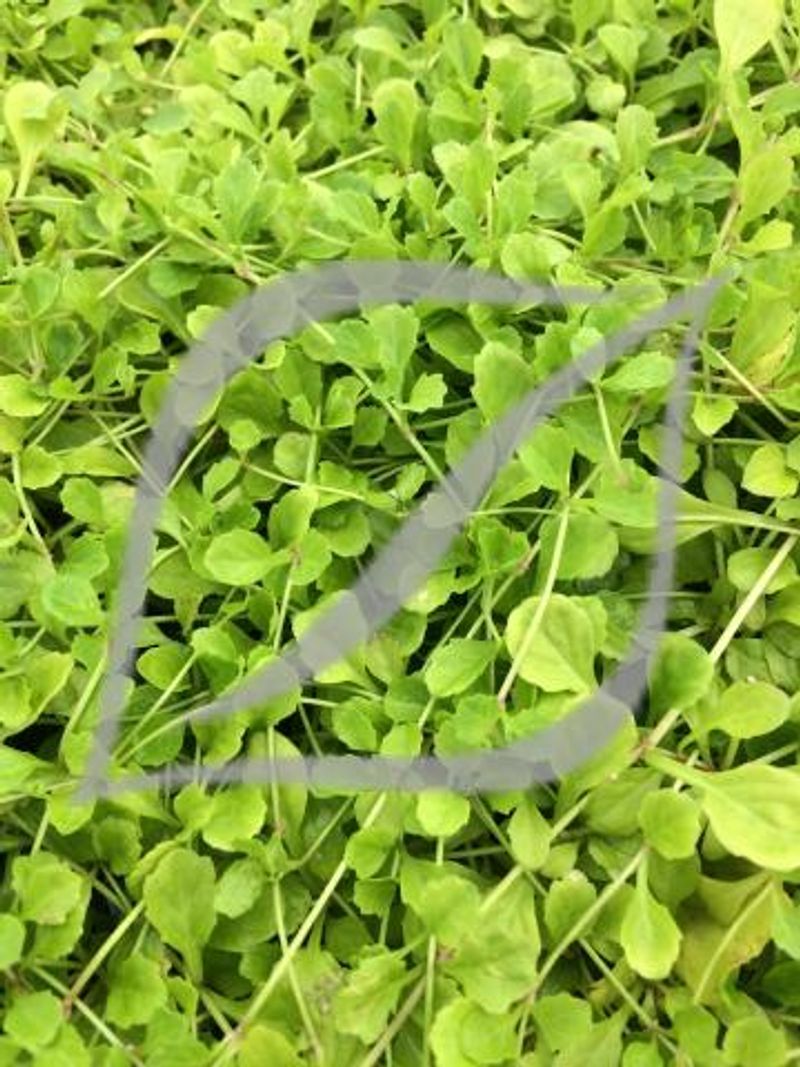
Image of Mazus reptans. Source: davesgarden.com
---
Mazus reptans prefers to be planted in full sun to obtain spectacular flowering, but tolerates light shade.
It is advisable to use a planting density of about 4 to 6 units per square meter in m-11 pot or with 1L pot.
It is a species that tolerates occasional watering, it will even have a better appearance if we water it, but it is drought tolerant and can be used in sustainable gardens with low water requirements.
Finally, one of the best-known species is _Phyla nodiflora_ or very popularly known as Lippia. It is from the Verbenaceae family, native to South America and the Mediterranean region, as well as subtropical climate regions.
Lippia can reach a height of 1 to 10 centimeters depending on moisture conditions, shade or sun and trampling; in width it spreads a lot, up to a meter in length. The stems produce roots at each node in contact with the soil. The plant grows quickly and has a tendency to colonize all free space even to dominate over other ground cover species.
Its flowering period is in spring-summer. Giving very abundant white-pink flowers, with a honey scent that attracts wasps and other insects.
Image of Phyla nodiflora. Source: flowerspictures.org
Its exposure can be both in full sun and in partial shade. If so, we will obtain a taller and less compact plant. It belongs to hardiness zone number 8, with an annual minimum average temperature range of -12.2 / -6.7°C, so it can tolerate frosts. If so, it will behave as a deciduous species, losing foliage in winter. In case of intense drought, the foliage can also dry partially in summer, but the plant greens quickly with the first rains.
It is a species that is tolerant to salinity and sea breeze, so we can plant it in places near the sea.
Very undemanding about soil nature. Of the species available at Sala Graupera, it is one of those that supports the most intensive trampling and therefore constitutes an excellent alternative to lawns.
We recommend using 4 to 6 units per square meter in m-11 pots as it is a species with rapid and effective colonization.