
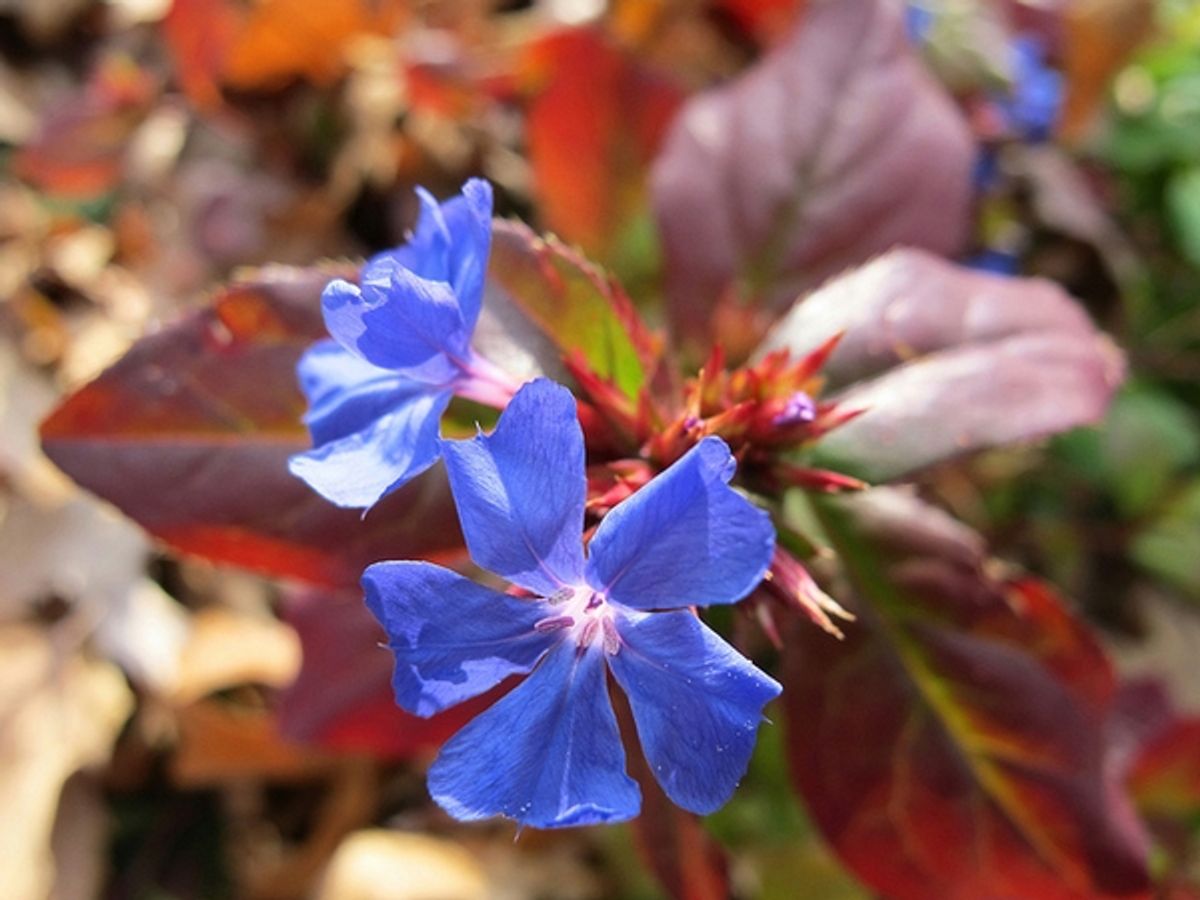
In this post we will talk about a low-growing plant very colorful in summer, from the genus Ceratostigma, the Ceratostigma plumbaginoides. It is one of the few deciduous plants we have in our nursery and belongs to the Plumbaginaceae family, from China.
It can measure 20/30 centimeters wide by 20/30 centimeters high; as we can see, it is a low-growing plant that will give us a lot of color and structure during spring, summer and autumn.
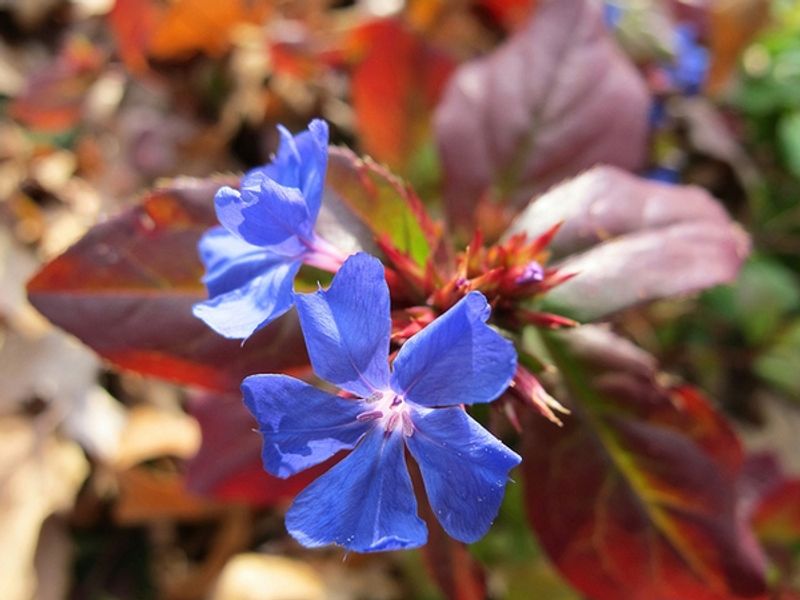
Shrub with semi-persistent leaves, in very cold climates, during winter, it completely loses its leaves. Its obovate, acuminate and slightly denticulate leaves, dark green in color that turn red in autumn, will contrast in the garden with other species of lighter colors.
The flowering, in a very striking electric blue color, occurs throughout the favorable time of the year, during the months of July to October. The flowers are grouped in terminal clusters.
It is a species belonging to hardiness zone 7, with an average annual minimum temperature range of -17.7 / -12.3°C, proving to be resistant and very strong. That is why it is an ideal species for summer houses in high mountains. Since during the cold winter it will not require any care, and with the arrival of good weather they will bloom in all their splendor.
Ceratostigma plumbaginoides has proven to be a drought-tolerant species. It only requires support watering during the 12-14 weeks after planting; once well rooted it requires occasional watering, especially in the driest months of summer. It is interesting to cover the soil with some type of mulch to retain soil moisture and prevent the appearance of unwanted weeds. From Sala Graupera we recommend planting in early spring, so that the plant has all spring to develop a root system deep enough to successfully survive the first summer.
Its preferred location is in full sun; if this location is not possible, it can tolerate light shade, but this will affect the compactness of the plant and the decrease in the number of flowers. It is suitable in very monotonous sustainable gardens, when we want to break up the green by giving a touch of color.
It grows well in both sandy and clay-heavy soils, as long as they have good drainage. No type of fertilizer is necessary unless it grows in a container.
We can consider it a very functional plant as it adapts to all types of gardens, including those near the sea, as it is a species resistant to salinity and sea breeze. It can also be used to create dense masses of low height development. It is also suitable for planting in containers or planters on terraces and balconies.
The recommended planting density is 5 plants per m2 if we want to achieve a uniform mass, or 4 per linear meter if we seek to create a border.
It is a highly recommended and versatile plant that we encourage you to try.