
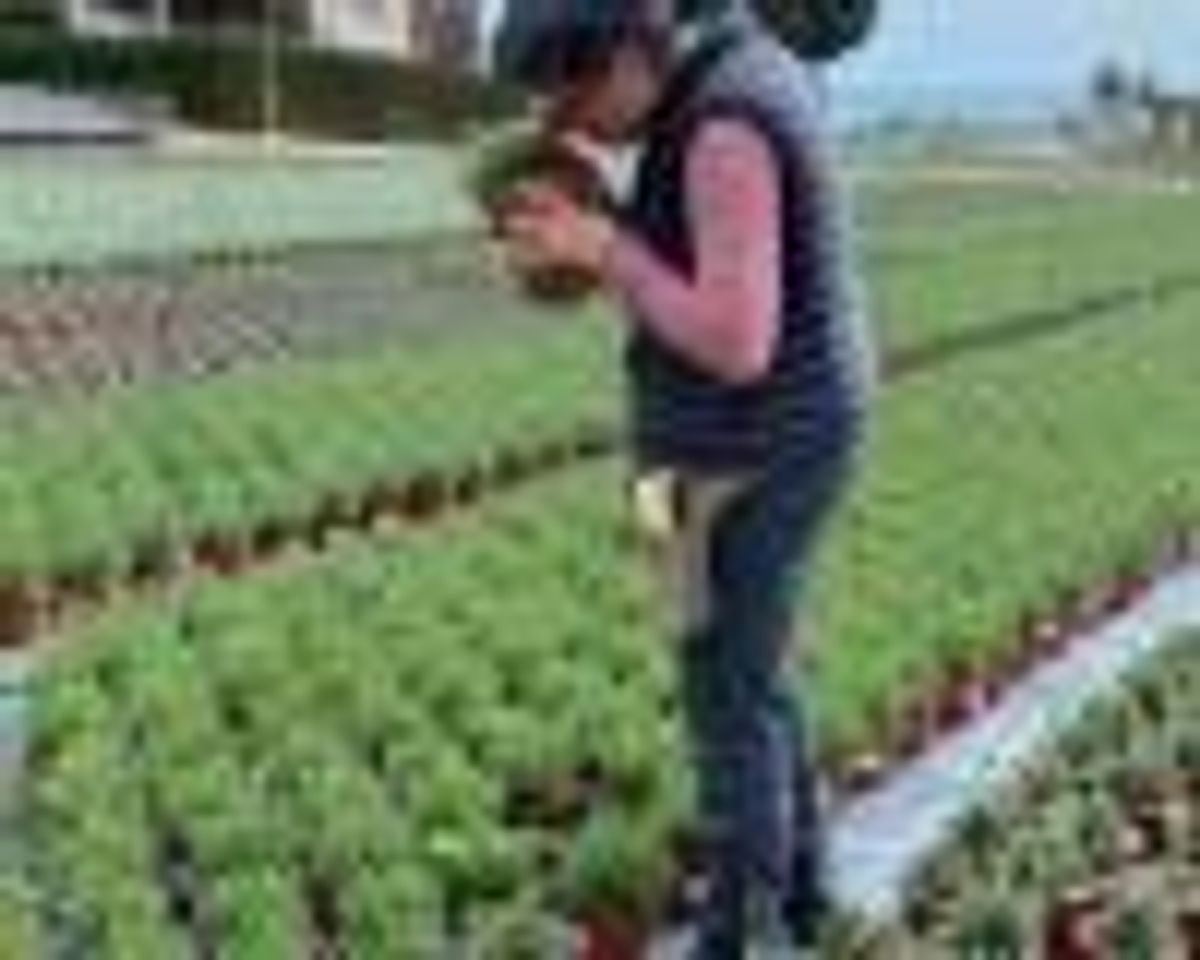
If you visit Bioaccio's Instagram account (Instagram.com/bioaccio/) you will quickly get an idea of who Judith Meseguer is. There you will find images of trips accompanying plant producers, close-ups of small insects that sometimes cause problems and other times solve them, and the occasional birthday cake with an immense "Per molts anys, mama" (Many more years, mom).
Judith Meseguer, Agricultural Technician from the University of Girona, created Bioaccio just over five years ago - although with more than fifteen years of experience in the sector - with a primary objective in mind: helping farmers find solutions to the plant health problems that arise daily. And doing so with the utmost respect for the environment, that is, making the most of all available resources while trying to affect as little as possible. She has been collaborating with SalaGraupera for just over three years and during this time has managed - even being an external partner to the company - to become an active part of the team that runs the company in terms of cultivation. Her work at SalaGraupera is key, as she is responsible for cultivation control, seedling management, and pest eradication. Quite a challenge.
As a child, she didn't want to be an Agricultural Technician - probably because she didn't even know what that was - but she did want to help: "I had considered dedicating myself to social assistance, to helping people" and while she may not be doing it in one way, she certainly is in another.
She is openly positive. Despite knowing that cultivating (she calls it making a plant grow) is a difficult task, she chooses to look for the most favorable aspects, finding solutions to make it less difficult and more profitable work, both in personal, economic, and business terms. That's why she even gets involved in advising in areas that go beyond cultivation. Marketing or communication are also topics that can be discussed with Judith Meseguer. In these last two years, marked by the pandemic, decreased consumption, and reduced mobility... she has tried to always be at the ready with her advice, her analyses, and her technical and business support.
Judith, contrary to what one might erroneously think, is not against the use of chemicals in the cultivation process. What's needed is to make good use of them, she affirms. "Their eradication is unviable if what we want is to get a return from the work we do. Today there are problems for which there is no solution other than the use of chemical products." That's probably why she foresees a certainly complex future ahead, since the goal of having reduced the use of phytosanitary products by 50% by 2026 will not be easy. Thus, she leaves a question in the air: are there real alternatives? Despite the doubt, she believes that the path we are on is correct, since we are moving towards a greater balance between respect for the environment and methods for controlling cultivation-related problems. In this regard, she highlights the work of new cultivators. They have more open minds, she tells us, and they dare to work with fewer pesticides or to incorporate actions with reservoir plants. She misses more people (professionals, urban planners, architects, or individuals) who want to implement more green in the streets. "It's hard to integrate green into urban planning."
Judith confesses to us that being a woman in the professional environment she works in hasn't always been easy, that you always need to demonstrate a little more than what is demanded of a man, but that when a professional relationship stabilizes, "the trust is extreme and you feel very loved and valued." And it's precisely then when the work is most fruitful, when more than a collaborator, she becomes part of the company she is working for.
Hers is frontier work. Trying to play at the limits: as few chemicals as possible and as many biologicals as possible to achieve maximum return with minimum risk. It's not an easy equation, but Judith lives it with calm and full awareness: "The eradication of chemicals is unviable if the goal is to get a return from cultivation. We have to consider them allies," but it's necessary to combine them with other elements - the biologicals - that provide us with balance. And she says it with all clarity, without hesitation, with the transparency of someone who knows she holds part of others' success in her hands, but with all the intensity of someone who affirms that "when a plant dies, there's a void" that she, with her daily work, helps to fill abundantly.
Brief questionnaire
A plant: Hibiscus
A little animal: the cat
A public garden: la Devesa (Girona)
A landscape: el Montgri
A country: Catalonia
A city: Girona
A person: my husband
A book: Anne Frank
A music: Tina Turner
A characteristic trait: honesty