
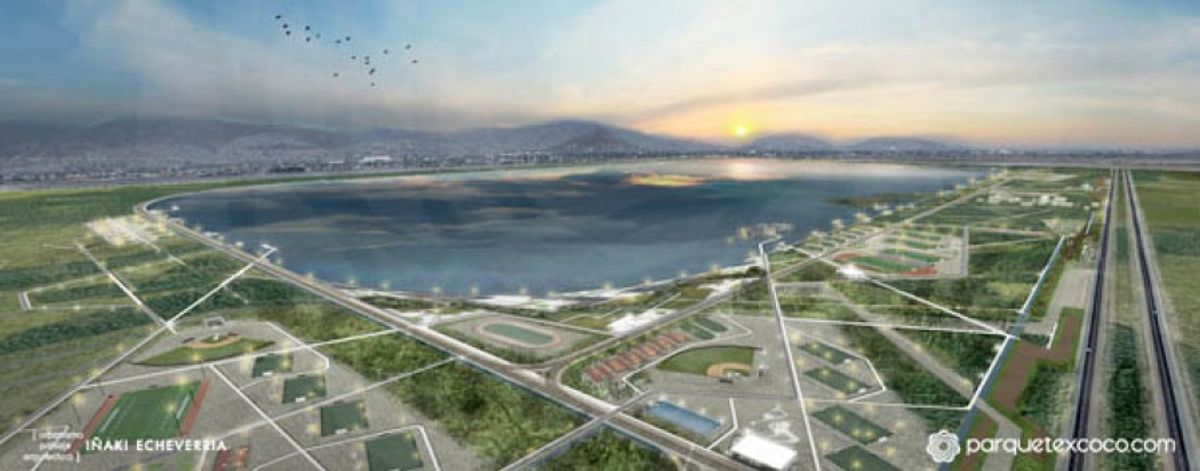
In Mexico City, construction has begun on the first phase of the new Texcoco Lake Park. This city is one of the largest urban agglomerations on the planet and the largest in America. Located on the central plateau of Mexico, at 2,000 meters above sea level, the conurbation of the Mexican capital has a population of around 21 million inhabitants.
At a conceptual level, one of the premises of this project was the confirmation of megalopolises as a reality in future urban developments in the world and their claim as a viable urban system, an issue that has recently been questioned by urbanism.
The new Park, located on the edge of the metropolitan area, with a surface area in line with the dimensions of the Mexican megalopolis, will provide the city with 14,300 ha of green infrastructure.
The project for the Texcoco Lake Park, by Mexican urban planner Iñaki Echeverría, is structured around hydrology. Water is used as the main organizing element, both urban and social. According to the author himself, if he had to summarize the spirit of the park in a single word, that word would be "balance", in reference to the hydrology and ecology of the Valley of Mexico.
In this sense, it is considered fundamental to enhance the recharge capacity of the aquifers that supply water to the city. In the Mexican capital, consumption is estimated at 82m3/sec, of which, 60m3/sec come from the aquifer. While, on the other hand, the estimate of the current recharge capacity of the aquifer is only 30m3/sec.
At the level of hydrological balance, the park also represents a great infrastructure to reduce the risk of flooding in the urbanized area of the Mexican capital, especially considering that, with a return period of only 50 years, a precipitation peak occurs that exceeds the current capacity of existing infrastructure. At this level the park will have a total hydrological capacity of 45 million m3.
The Texcoco Lake Park, in addition to addressing the hydrological problems of the valley, proposes solutions to other problems of this great city such as reconciling the city with its geography, the creation of a new ecological edge of the city, the establishment of native biota in this place, the implementation of clean energy creation systems and the provision of quality facilities and public spaces in the most socially depressed region, from an economic point of view, of the metropolitan area.
More information here