
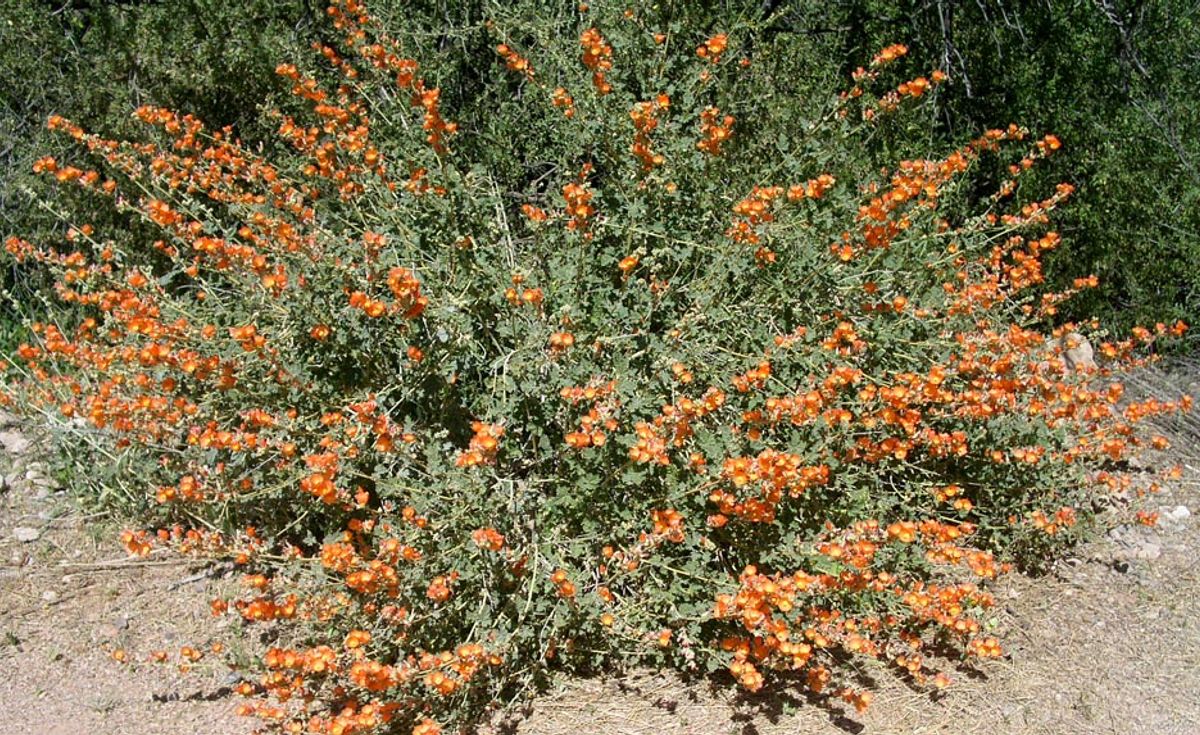
In this article we will talk about a species that from Sala Graupera we believe can have great potential in our gardens. It is Sphaeralcea ambigua.
It is a shrub, from the Malvaceae family. Sphaeralcea comes from the Greek Sphaera, 'globe', and Alcea, genus of the Malvaceae, whose name refers to protecting or defending, possibly due to the medicinal properties of this genus.
This species is native to the semi-desert areas of the southwestern United States, where it is popularly known as "desert globemallow", desert mallow. Its dimensions once adult are approximately 100/125 centimeters high by 80/100 centimeters wide. This indicates that it is a shrub of considerable dimensions, which is why its adult dimensions must be taken into account when planting it to give it an ideal planting framework.
Its origin gives us some clues about the conditions in which it likes to grow. Sphaeralcea ambigua tolerates calcareous soils well. It likes full sun exposure, light soils with good drainage. It is a very drought-resistant species, being able to go very long periods without watering.
The evergreen, palmate leaves, grayish-green in color, are slightly serrated along the entire edge.
The flowers are grouped in the axil, or upper part, of each leaf, in the form of small bell-shaped cups of salmon color, with intense orange veins. This species blooms throughout its growth period, in our latitudes it would be from May to October, which is why it is one of the plants that we still have in flower in our demonstration garden. In areas with milder weather it can bloom throughout the year.
Image of Sphaeralcea ambigua. https://alchetron.com/Sphaeralcea-ambigua-4492276-W
It is a species belonging to hardiness zone number 8, with an average annual minimum temperature range of -12.2 / -6.7°C. So it can withstand strong frosts in winter.
Its care is very simple, as it is enough to prune it quite short in late winter to promote more vigorous vegetation for spring. If we do this care once a year, and thanks to its rhizomatous rootstock, we will manage to form a large light and rounded mass. Another very important care to perform to favor its correct development is good establishment watering, this should be about 10 weeks, where waterings will be done with a large amount of water and spaced over time, in this way we will favor proper root development.
It is a highly recommended plant, which from Viveros Sala Graupera we advise you to try.