
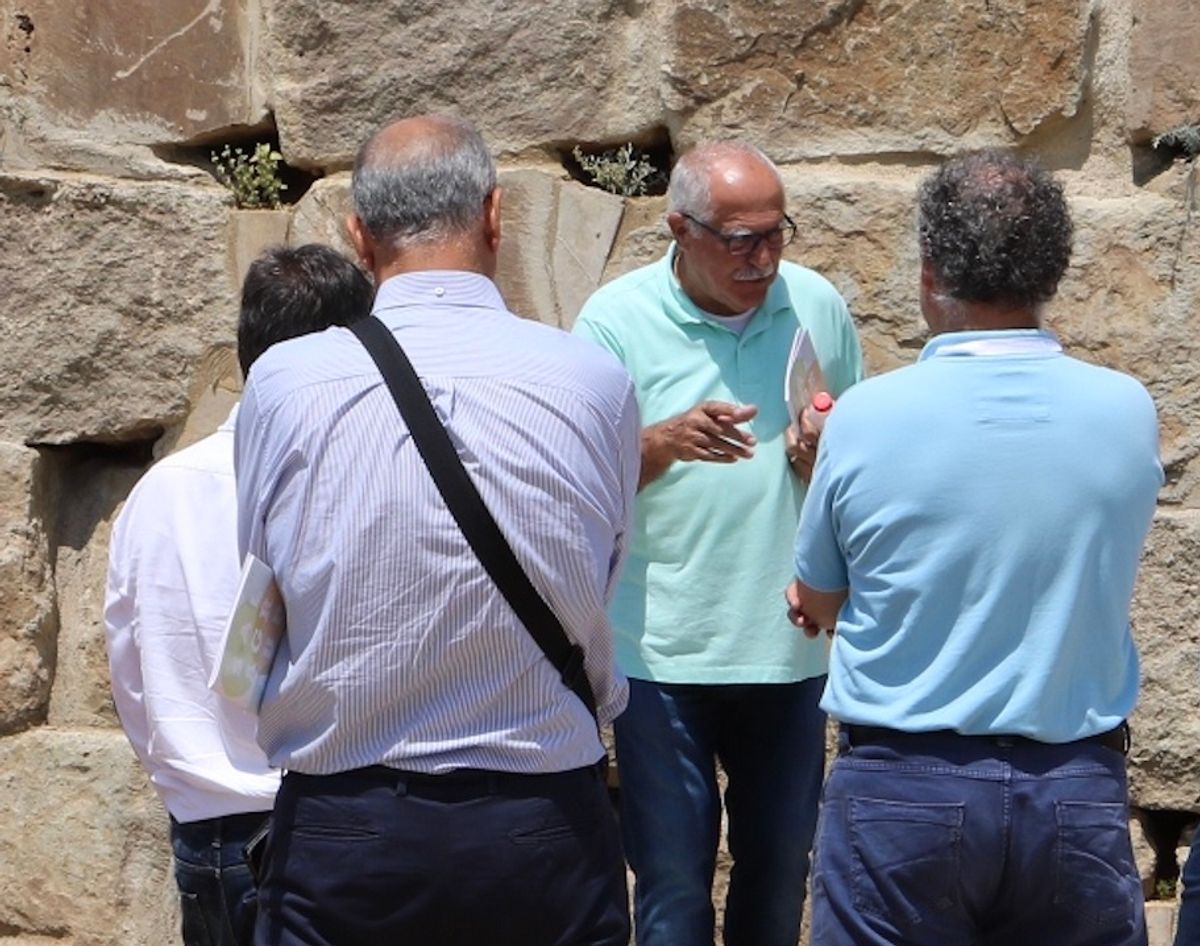
Lluis Sala. More than fifty years making SalaGraupera
I am a plant caretaker. Lluis Sala and his brother, Albert, have been at the helm of SalaGraupera throughout the last decades and together they have commanded not only the transformation of the nursery that their father had - when gardeners took advantage of slower work periods to cultivate their own seedlings - but also a certain way of understanding nursery work. An open and traveling approach that can quickly be linked to the great nurserymen, those who set trends and mark eras.
Lluis was trained at the Rubio i Tuduri school in Barcelona, but it was really at the family nursery where he could verify that what he truly liked was not vegetables but flowering plants, and when the necessary question from his father came: what do you want to do? The matter was practically resolved. Lluis wanted to be a gardener, but not just any gardener, he wanted to be a different gardener. And so he has been.
One of his first experiences was with 25 different species from what was usual around here - in the Maresme region. They were plants from Belgium that, in some way, marked a way of doing things. Always looking outward, always attentive to a more open vision than usual, and always one step ahead because, when people were barely starting to talk about it, Lluis and by extension SalaGraupera, was already beginning to work with sustainability on the horizon. When everyone wanted to sell green gardens as if they were English spaces, Lluis's nursery was full of low-maintenance plants. More sustainable plants and more suited to a climate that was already pointing to change. We can say that Lluis was an environmental activist avant la lettre. When others worried about the showiness of plants above all else, at SalaGraupera they also worked on their resistance, to the point that very soon 60% of the cultivated plants already belonged to what we now call sustainable gardening.
Throughout all this time, there have been three names that have influenced Lluis Sala's work. Three names that in gardening and landscaping in this country are written in capital letters: Joan Bordas, Josep Batlle, and Maria Isart. All three have been a reference primarily for their thirst for knowledge which, as in Lluis Sala's case, led them to travel everywhere looking for different plants that could be incorporated into local gardens. A search that, besides difference, sought performance. Plants that could live more or less comfortably in our gardens. It was a moment that could be described as botanical expansion when up to 800 different species were worked with. It's not easy, but the vision it provides and the possibilities that such a fact opens are immense. Working this way allowed Lluis to realize that plant propagation was a fascinating task and that mastering it allowed him to create a different, much more extensive catalog, and that knowing it in depth made it possible to explain it and that all of this contributed to spreading sustainable gardening. This fact is still part of the company's ideology today and is reflected in very concrete realities: a display garden that allows visitors to see the evolution and results of plants in a real habitat, which also makes it possible to explain it to the many visitors the nursery receives throughout the year (schools, professionals, practice groups), or a website with the complete catalog and detailed characteristics of each plant. Verified with their own experience and with at least five other reference websites. An enormous task that confirms what it seems: knowledge is the main axis of Lluis's activity. "I am learning," he tells us. A learning that has already lasted for more than fifty years and that he insists would not have been possible if he had not had his brother's full trust. Total partner and accomplice at SalaGraupera.
"My brothers have been my guarantee to be able to make a better nursery, different from the others."
With this eagerness, he is now working on the causes and effects that insects and butterflies have on plants in the areas where they live and reproduce. "After so many years, I have now moved to observing fauna, because flora and fauna cannot be dissociated." He started with birds and from there to the world of insects. What species are there, how they live, what they eat, how they relate to flora. More than three months working on an insect hotel.
In addition to travels and personal references, Lluis also refers on more than one occasion to a much closer garden such as Barcelona's Botanical Garden in Montjuic, which he describes as an example of biodiversity, especially in its early days. A fact that cannot be minor if there is a certain willingness to replicate what nature offers us. He states it more categorically: "Parks must be biodiverse." And he practices it, as we have said, with a catalog that has exceeded 750 species.
However, talking with Lluis Sala is not just about remembering. It's about being clear about where the future must go. "We have four major challenges ahead: pest management, fertilization, drought, and rising sea levels," he tells us. No speculation, tangible facts that must contribute to establishing a better and more viable future. But not only that. We must learn to look more carefully at what is not seen: "We must learn that the soil contains a lot of life." He believes that to cultivate the land, you don't need to break it up so much, it's not essential to plow so deeply if we want to see a decrease in plant diseases. And also that we must look further ahead and foresee the end of peat. Lluis affirms, with all vehemence, that at least half the success in plant cultivation responds to a good selection of the substrate where we do it. The plant has an aerial part and an underground part, and both are important. One as much as the other. And he tells us about the composition of some of the substrates he has worked with over time: peat, coconut, organic... all of them components of formulas that at some point have made cultivation a success.
The future also involves incorporating green culture into common knowledge.
Green culture, whether we want it or not, we will incorporate it as climate change provides us with evidence, and we will have to introduce it into our daily lives in which the contribution of architects is important, but no less than that of developers: "We need developers who want more green areas in their projects and the administration must also be involved." In this sense, Lluis Sala is an active person. For years he has been a member of the jury that evaluates the actions of Catalan municipalities in the context of the VilesFlorides project, a project that rewards good gardening practices (not just the presence of plants in public spaces) of the towns and cities of Catalonia. This work has led and continues to lead him to visit numerous municipalities, which allows him to continue doing educational work among those responsible for public gardens and to encourage citizens to take responsibility in this collective task of promoting and preserving public green space.
And in the nursery, what should be the essence of the future? Lluis is clear about it. It must be based on three main pillars: service above all, respect for the environment with low-resource consumption nursery work (water, fertilizers), and knowledge that goes beyond technique.
Let's call it passion, if we want. Let's call it love, if we prefer. Or knowledge. All three, engines of what has been and still is one of the most prolific and discreet trajectories in nursery work and gardening in our country. That of Lluis Sala, plant caretaker.